Why Are Leads Not Converting? Fix the Leaks
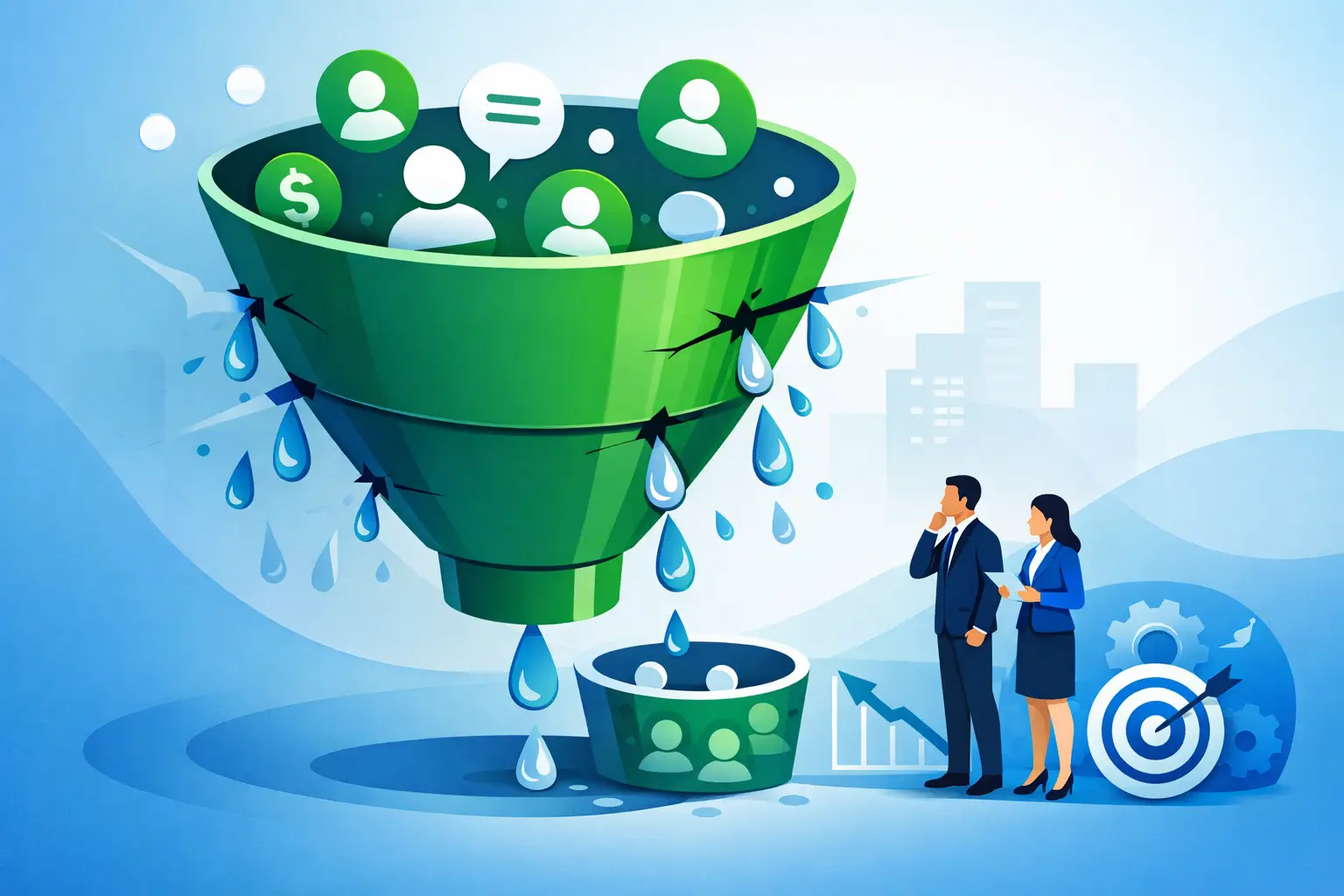
A steady flow of form fills can feel like progress right up until payroll is due and the calendar is still half empty. If you are asking, “why are leads not converting,” the answer is rarely that you need more leads. More often, you are paying to send more people into a sales process with a broken handoff, vague offer, or slow response time.
That is good news. A conversion problem is measurable, and anything measurable can be fixed. The goal is not to chase a magic conversion rate. It is to identify the exact point where qualified prospects stop moving forward, calculate what that leak is costing you, and repair the highest-value issue first.
Start with the math, not the excuses
Owners commonly label every non-customer as a bad lead. Sometimes that is true. But without tracking the full path from click to booked job to closed sale, it is an assumption that hides expensive problems.
Look at the numbers for the last 30 to 90 days. How many leads came in? How many received a response within five minutes? How many booked a consultation, estimate, or appointment? How many showed up? How many bought? Then calculate revenue at each stage.
For example, a clinic receives 100 inquiries per month and closes 15 patients at an average value of $1,200. If better follow-up increases closed patients from 15 to 20, that is $6,000 in added monthly revenue without adding a single lead. That is the kind of math worth acting on.
Do not diagnose from overall conversion rate alone. A 5% lead-to-sale rate may be excellent for a high-ticket legal service and terrible for an urgent home-service request. The useful question is where the drop-off happens compared with what a serious buyer should reasonably do next.
Why are leads not converting after they inquire?
The highest-cost leaks usually appear in one of four places: lead quality, offer clarity, speed to lead, and sales execution. They often overlap. A strong lead can be lost by a weak process, while a weak offer makes even a skilled salesperson work too hard.
You are attracting clicks, not buyers
Traffic is not the same as demand. Broad Google Ads keywords, generic social campaigns, or a website built around vague phrases like “quality service” can bring in plenty of people who were never close to buying.
A local roofing company that advertises “roof repair” may attract homeowners looking for DIY advice, tenants who cannot authorize work, and shoppers seeking the lowest possible price. A better campaign separates emergency repairs, storm damage claims, and full replacement estimates. Each has a different urgency, budget, and message.
Review your lost leads by source. If Google Ads leads book and close while leads from a broad lead marketplace disappear, do not call it a sales problem. Shift budget toward the source producing profitable customers. Lead volume without source-level accountability is how marketing spend gets wasted.
Your offer gives prospects no reason to act now
Many service businesses explain what they do but fail to make the next step easy or valuable. “Contact us for more information” is not an offer. It puts the work back on the prospect.
A better next step is specific: a same-week estimate, a 15-minute eligibility review, a diagnostic appointment, or a clear assessment of potential savings and options. It must match the purchase. A free consultation works for a complex professional service. An emergency plumber needs a direct promise around availability and response time, not a lengthy education sequence.
Clarity matters more than cleverness. Your website should answer three questions fast: Is this for someone like me? What result can I expect? What happens after I contact you? If visitors cannot answer those questions in 10 seconds, your landing page is creating hesitation before the sales team ever gets a chance.
Your response time is killing intent
A person who submits an inquiry at 10:15 a.m. and hears back the next morning has probably contacted three competitors. This is especially true for high-intent local services, where the buyer has an immediate problem and very little loyalty to the first business they find.
Speed does not mean having someone manually stare at a phone all day. It means building a system that immediately confirms the request, alerts the right person, captures the lead in one place, and triggers a real follow-up task. An automated text can acknowledge the inquiry and set expectations. It cannot replace a capable human conversation when the prospect is ready to talk.
Measure first-response time by lead source and by team member. Then set a standard your business can actually maintain. For urgent services, that may be under five minutes during business hours. For a more considered B2B sale, the standard may be same-day, paired with a useful and personalized response.
Your follow-up stops before the buyer is ready
Most leads do not convert on the first call. They get busy, need to speak with a spouse or partner, compare options, or simply avoid a decision. That does not make them dead leads.
The mistake is relying on memory and individual effort. If a salesperson has to remember who needs a callback, which estimate expires Friday, and which prospect asked for financing details, follow-up will fail as the business grows.
Create a defined follow-up path for every legitimate inquiry. It should include timely calls, concise text or email reminders where appropriate, and a clear reason to re-engage. An estimate follow-up can answer a common objection, clarify scope, or remind the prospect of scheduling availability. It should not be a string of empty “just checking in” messages.
Automation helps here, but only after the process is sound. Automating a vague, inconsistent follow-up process simply sends more vague, inconsistent messages faster.
The hidden gap: marketing promises one thing, sales delivers another
A lead may arrive expecting one price range, timeline, or outcome and get a different story on the call. That gap usually begins in the ad or landing page, then becomes visible when a prospect talks to your team.
Listen to recorded calls where possible, or have someone review notes from lost opportunities. Look for repeated language: “I thought this was free,” “I did not realize you only serve commercial clients,” “That is more than I expected,” or “I need to think about it.” These are not just objections. They are evidence.
Sometimes the fix is better qualification. Add service areas, starting prices, project minimums, or eligibility requirements before the form. You may get fewer submissions, but your team will spend more time with viable buyers. For a capacity-constrained service business, that trade-off is usually profitable.
Other times the fix is sales training and scripting. If your team responds to price questions by immediately discounting or listing features, they are leaving value unexplained. A better sales conversation identifies the problem, confirms the cost of doing nothing, explains the recommended path, and asks for a concrete next step.
Fix one bottleneck before buying more traffic
It is tempting to redesign the entire website, replace the CRM, hire another salesperson, and increase ad spend at once. That creates noise. You will not know what improved results or what created another problem.
Start with the bottleneck carrying the biggest financial impact. If 40% of leads are never contacted within an hour, fix routing and follow-up first. If calls are answered quickly but only 10% are qualified, tighten targeting and landing-page expectations. If qualified appointments show up but do not close, review the offer, sales conversation, and proposal process.
Use a short testing window, usually 30 days for services with a reasonably fast sales cycle. Track the baseline, change one meaningful variable, and compare results. If the change does not produce a measurable improvement, do not protect it because it sounded smart in a meeting.
Build a conversion system your team can run
The best lead generation systems are not dependent on one heroic employee. They make the right action obvious: where leads land, who owns the response, how quickly they respond, when follow-ups happen, and how outcomes are recorded.
That structure gives you a cleaner picture of marketing performance too. You can see whether Google Ads are producing booked appointments, whether your website is filtering the wrong people out, and whether the sales team has the capacity to handle the demand you are creating. Without that visibility, “we need more leads” becomes the default answer to every revenue problem.
At Nils Digital, we have seen the same pattern across more than 200 businesses: growth rarely stalls because an owner lacks effort. It stalls because the path between interest and revenue has too many unmeasured handoffs. Fix the handoff with the biggest dollar value first, then earn the right to scale.
Ready to turn your website and lead flow into a client-getting machine? Book a free strategy call with Nils Digital. Bring your current numbers. The fastest path forward is usually clearer than it looks once the leaks are on the page.