AI Audit vs Process Consultant: Which Pays Off?
Your operations manager is spending Fridays fixing handoff mistakes. Your team rekeys the same client details into three systems. Leads wait hours for a response because one person owns the inbox. The question is not whether those problems cost money. It is whether an AI audit vs process consultant gives you the fastest, most profitable way to fix them.
For established service businesses, this is not a theoretical choice. It determines whether you get a clear roadmap to recover payroll and capacity, or a broader operating model that may take months to redesign. Both can be valuable. They solve different problems, and hiring the wrong one can leave you with an expensive report, a pile of software subscriptions, or a process diagram that never changes what your staff does on Monday morning.
What an AI audit actually does
An AI and automation audit examines the work moving through your business and finds where people are doing repeatable tasks that technology can handle faster, more consistently, or both. The goal is not to add AI because it sounds modern. The goal is to connect workflow failures to a number: hours lost, payroll spent, missed follow-ups, delayed cash collection, or revenue that never reaches the pipeline.
A useful audit looks across marketing, sales, onboarding, fulfillment, billing, and internal operations. It traces how a lead becomes a client, how information moves between people and tools, where approvals stall, and what happens when a team member is out sick or overloaded.
Then it ranks possible fixes by financial impact. For example, an intake automation may eliminate 12 hours of manual data entry each week. A missed-call text-back workflow may protect leads that were previously lost after business hours. An automated billing follow-up may shorten the time between completed work and collected cash.
The output should be specific enough to act on: the workflow, the bottleneck, the recommended solution, the estimated return, implementation effort, and the order in which to do the work. If someone cannot explain the math behind a recommendation, it does not belong at the top of the roadmap.
At Nils Digital, that means delivering a tailored 14-day roadmap that clients keep whether they implement it internally or bring in a team to build it. That matters because you should not need to sign an open-ended engagement just to understand where your own money is leaking.
What a process consultant does differently
A process consultant typically takes a wider operational view. They may map a department, document standard operating procedures, redesign roles, establish performance metrics, recommend software, or help leadership change how work is governed across the company.
That work is often valuable when the core issue is not repetitive manual work. If your fulfillment department has unclear ownership, inconsistent quality standards, poor management reporting, or a broken pricing and capacity model, automation alone will not solve it. You may need someone to redesign the process before you automate any part of it.
The trade-off is speed and scope. Traditional process consulting can involve interviews, workshops, documentation, stakeholder alignment, pilot programs, and change management. For a business with multiple locations, complex compliance requirements, or a large team, that depth may be necessary.
But for a 15-person agency, clinic, real estate team, or professional service firm, a broad transformation project can become overbuilt. You can spend months documenting a workflow that could have been improved in two weeks by routing leads correctly, standardizing intake, and eliminating duplicate data entry.
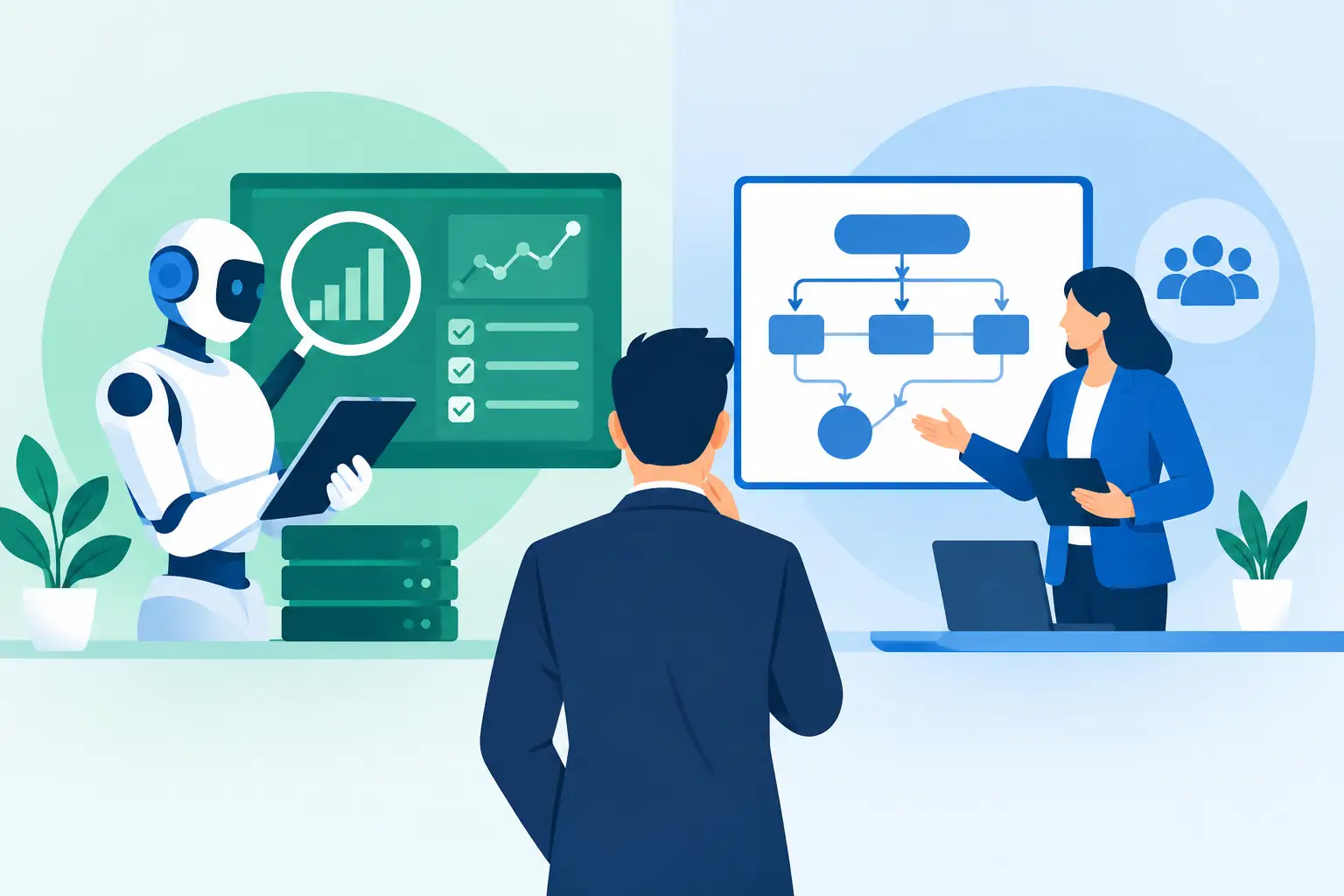
AI audit vs process consultant: the real comparison
The distinction comes down to the question you need answered.
An AI audit asks: Where are we losing time or money right now, and which automations will recover the most of it first?
A process consultant asks: How should this function or organization operate in the future?
Neither answer is automatically better. The right answer depends on the kind of friction holding your business back.
An AI audit is usually the stronger fit when your team already knows how work should happen, but execution is slowed by manual steps, disconnected software, inconsistent follow-up, and repeated copying of information. These businesses do not need a 60-page operations manual before they act. They need the high-value leaks identified, quantified, and fixed in the right order.
A process consultant is often the better fit when leadership itself disagrees on the process, responsibilities are unclear, the business is preparing for a major restructuring, or the workflow is fundamentally broken. Automating a bad process only helps you make mistakes faster. If the process has no owner, no standard, and no agreed outcome, fix that first.
The implementation gap matters
There is another difference owners often discover too late: recommendations are not implementation.
Some consultants diagnose problems well but hand the work to your already-busy internal team. Some automation vendors sell a platform before they understand your workflow. Some freelancers can connect tools but lack the business judgment to decide whether the automation is worth building.
The best partner can move from diagnosis to action without losing the financial thread. They should be able to say, "This workflow costs you roughly $3,200 per month in staff time and missed follow-up. Here is the simplest fix. Here is what it requires. Here is what we expect it to return." Then they should either build it or give your team a plan detailed enough to build it correctly.
That is particularly important for service businesses. You cannot pause client delivery for a six-month transformation program, and you cannot afford to gamble on flashy tools that your staff quietly abandons after two weeks.
How to choose without buying another expensive report
Start with the business problem, not the vendor category. Look at the last 30 days and identify where work piles up, clients wait, cash gets delayed, or your best people spend time on tasks that do not require their judgment.
If the answer is obvious and repeatable, such as lead routing, appointment reminders, intake forms, document collection, status updates, invoice reminders, or reporting, begin with an AI audit. You are likely dealing with an automation opportunity that can produce a measurable return quickly.
If the answer is political or structural, such as unclear service standards, departments blaming each other, inconsistent delivery models, or a leadership team that cannot agree on ownership, start with process design. You may still use AI later, but it should support a defined process rather than replace one.
Before you hire either option, ask four direct questions:
- What specific workflows will you review, and how will you prioritize them?
- How will you calculate financial impact rather than just list inefficiencies?
- What will I receive at the end that my team can use without you?
- Can you implement the recommendations, and what does that phase look like?
Listen for clear answers. "We will find efficiencies" is not an answer. Neither is a generic promise to save time. A credible provider can explain what they will examine, how they will value the opportunity, and what the next 30 to 90 days should look like.
Don’t automate around a people problem
AI can remove repetitive work. It can draft, sort, route, summarize, remind, and trigger the next step faster than a person moving between inboxes and spreadsheets. It cannot make an untrained team accountable, repair a bad client offer, or decide which exceptions require human judgment.
That is why the most profitable audits do not recommend automating everything. They identify where automation supports good staff and where a person should remain responsible. For example, an automation can qualify inbound inquiries and schedule a consultation. A trained team member should still handle a high-value prospect with unusual needs. The point is to reserve human attention for work that actually needs it.
A smart roadmap also starts small enough to prove value. Fix the workflow with a clear owner, measurable baseline, and visible pain. Once it works, expand from there. That approach creates confidence with your team and prevents a major technology project from becoming another operational burden.
The best next step is not the most impressive system. It is the change that gives your business back time, protects revenue, and lets capable people spend more of their week serving clients instead of chasing information.
Want to know exactly where AI could save you 20+ hours a week? Book a free call with Nils Digital’s automation team.