What Does an AI Audit Include?

If your team is still copying data between tools, chasing approvals in Slack, and fixing the same admin mistakes every week, the real question is not whether you need AI. It is what does an AI audit include, and will it show you where the money is leaking.
A good AI audit is not a software demo and it is not a generic report stuffed with buzzwords. It is a business diagnosis. The point is to find where manual work, delays, handoff errors, and inconsistent processes are slowing growth or eating margin, then turn that into a clear financial case for automation.
For service businesses, that usually means looking beyond marketing. The biggest gains often sit in the work that happens after a lead comes in - intake, follow-up, scheduling, onboarding, fulfillment, billing, reporting, and internal operations. That is where payroll gets burned quietly.
What does an AI audit include in practice?
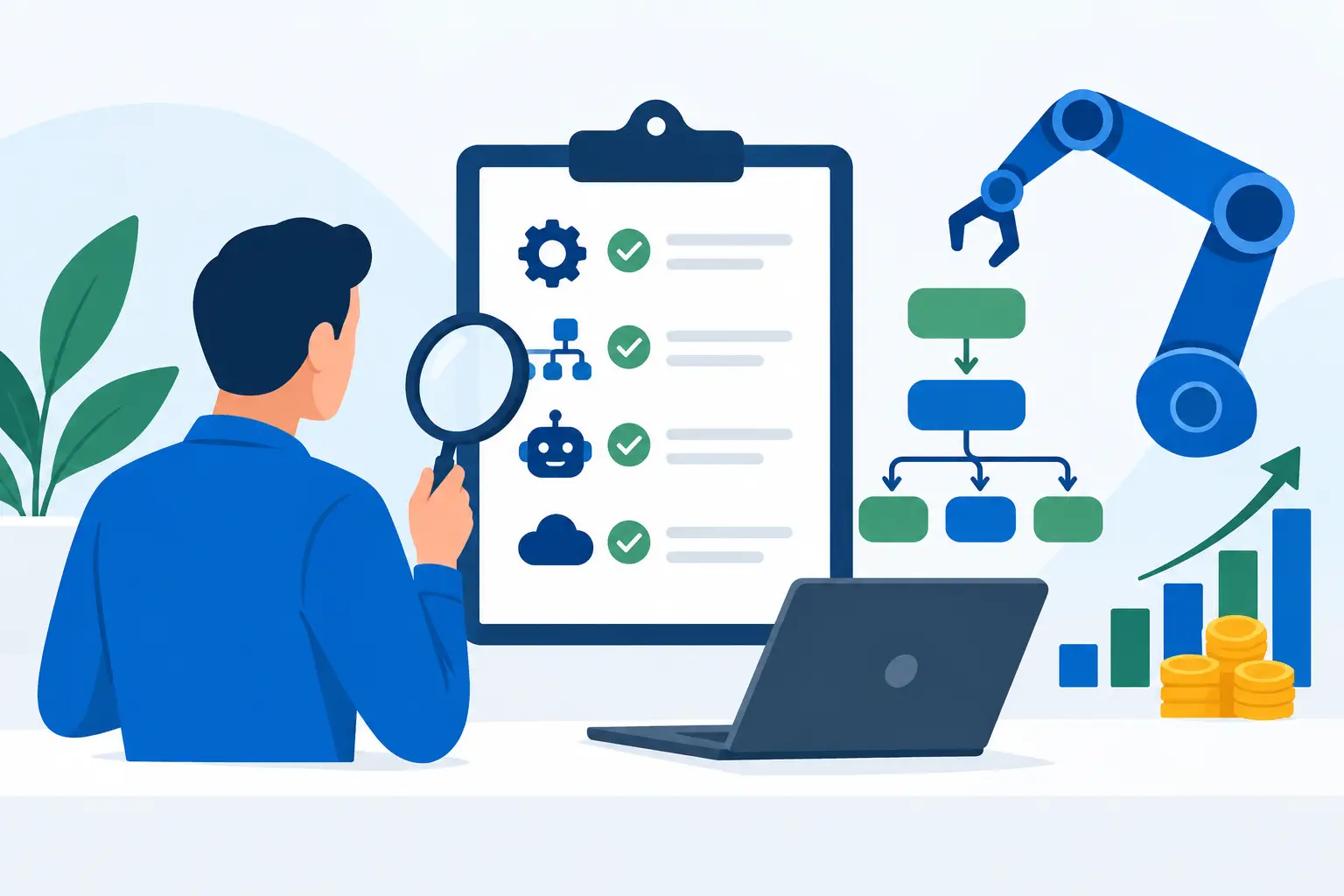
At a practical level, an AI audit should include four things: process mapping, waste detection, opportunity scoring, and an implementation roadmap. If one of those pieces is missing, you are usually not getting a real audit. You are getting advice without math.
The first job is understanding how the business actually runs. Not how the org chart says it runs, and not how the software vendor thinks it should run. A real audit maps the current workflow from first touch to final delivery and payment. That includes who does what, which tools are involved, where information gets re-entered, where approvals stall, and where errors show up.
From there, the audit should quantify the cost of friction. That means hours lost, payroll spent on repeatable tasks, revenue delayed because follow-up is slow, and money missed because billing or onboarding breaks down. This is where many AI consultants fall apart. They can tell you what is possible, but they cannot tell you what it is worth.
Then comes prioritization. Not every process should be automated, and not every AI use case is a good one. Some tasks are too rare to matter. Others are too sensitive to automate fully. A smart audit ranks opportunities by financial impact, ease of implementation, and operational risk.
Finally, the audit should leave you with a roadmap. Not vague next steps. A real plan: what to fix first, what systems are involved, what the projected payoff is, and what can realistically be built in the next 14 to 30 days.
Workflow mapping is the foundation
Most business owners think they know their workflows until someone puts them on paper. Then the gaps become obvious.
An AI audit should map workflows across marketing, sales, fulfillment, onboarding, billing, and operations. For a home service company, that may include lead intake, estimate follow-up, scheduling, job completion, invoicing, and review requests. For a clinic, it may cover patient inquiries, intake forms, appointment reminders, insurance verification, and post-visit communication. For an agency or professional service firm, it may include proposal generation, client onboarding, task assignment, reporting, and invoice collection.
The reason this matters is simple. AI does not fix messy operations by itself. If a process is inconsistent, undocumented, or dependent on one employee's memory, the audit has to identify that before any automation gets built.
Where the audit looks for bottlenecks
This part should be detailed. A strong audit looks for repeated points of failure such as manual data entry between systems, delays caused by internal approvals, no-shows caused by weak reminders, lost leads caused by poor handoff from ads to intake, or billing slowdowns caused by missing information.
It should also identify dependency risk. If one person is the only one who knows how to send proposals, update the CRM, or chase unpaid invoices, that is not just inefficient. It is fragile.
The financial analysis matters more than the tech stack
This is where an AI audit earns its keep.
Anybody can point at a process and say, "You could automate that." The harder question is whether automating it saves enough time or recovers enough revenue to justify the change. That is why the best audits calculate business impact in dollars, not just tasks.
A proper analysis usually includes time spent per task, frequency per week or month, employee cost tied to that time, error rates, and the downstream impact of delays. If a sales coordinator spends 10 hours a week chasing missing intake details, the audit should estimate the payroll cost of that work. If late follow-up causes leads to go cold, the audit should estimate the revenue being lost.
This is also where trade-offs come in. Sometimes a process looks annoying but is not expensive enough to fix first. Sometimes a smaller workflow creates a disproportionate financial drag because it affects collections, scheduling, or conversion. It depends on volume, labor cost, and how close that process sits to revenue.
What does an AI audit include when ranking opportunities?
Not all automation opportunities deserve equal attention. A real audit should rank them.
Usually that ranking comes down to three filters: impact, speed, and complexity. High-impact, low-complexity fixes should rise to the top. Those are the changes that recover hours fast, reduce expensive admin work, or speed up revenue collection without requiring a six-month rebuild.
For example, automating lead qualification and routing may be a fast win if your business loses prospects because nobody follows up quickly. Automating proposal creation may be worthwhile if your team builds similar scopes every day. But a fully custom AI assistant for a low-volume edge case might look impressive while doing very little for profit.
The audit should also separate pure automation from AI-enhanced automation. Some problems need simple workflow logic, not large language models. Others benefit from AI because they involve summarizing calls, extracting information from documents, drafting replies, or classifying requests. If everything is labeled AI, that is usually a red flag.
The roadmap should be specific enough to build from
If you finish an audit and still do not know what happens next, it was not done well.
A useful roadmap should spell out which workflows to address first, what the target outcome is, what data or tools are involved, what dependencies need to be solved, and what the expected return looks like. It should also make clear what can be implemented now versus later.
For many businesses, the first wave is not glamorous. It is the boring stuff that compounds: better intake capture, automated reminders, internal notifications, billing triggers, call summaries, task creation, and status updates across systems. That is often where the fastest ROI sits.
A strong audit also respects operational reality. If your team is already stretched, a roadmap should avoid dumping five major changes on them at once. The best plans sequence improvements in a way the business can absorb.
What should be included beyond workflows?
The strongest audits go one level deeper. They examine data quality, tool overlap, process ownership, and adoption risk.
Data quality matters because bad inputs produce bad automation. If customer records are inconsistent, if form submissions are incomplete, or if naming conventions are chaotic, the audit should flag that. Otherwise the build will fail later and the software will get blamed.
Tool overlap matters because many businesses are paying for multiple systems that do similar jobs. An audit should identify where software is redundant, underused, or creating more friction than it removes.
Ownership matters because someone has to maintain the system. If nobody owns the workflow after launch, even a good automation can decay fast.
Adoption risk matters because not every team embraces change at the same speed. A smart audit considers whether the proposed fix fits your staff, your sales process, and your service model. The best solution on paper is still the wrong solution if nobody uses it.
What a weak AI audit usually misses
Weak audits tend to focus on tools before economics. They show dashboards, promise big transformation, and skip the hard part: proving where the return comes from.
They also stay too high level. You hear things like "automate onboarding" or "use AI for operations" without seeing the exact trigger, action, owner, and payoff. That is not useful when you need to decide where to spend money.
Another common miss is failing to connect departments. Marketing, sales, fulfillment, and billing are usually treated as separate worlds. In reality, one broken handoff between them can cost more than five small inefficiencies inside one department.
That is why the audit has to look at the whole system, not isolated tasks.
So, what does an AI audit include if it is done right?
It includes a clear picture of how your business actually operates, where time and profit are being lost, which automations will produce measurable return, and what to implement first.
It should show you the math. It should show you the sequence. And it should help you avoid spending on flashy automations that sound smart but do not move the business.
That is the standard we use at Nils Digital. If we cannot back a recommendation with hours saved, dollars recovered, or a realistic payback window, it does not make it into the report.
Want to know exactly where AI could save you 20+ hours a week? Book a free call at nilsdigital.com/automation. The best audits do not give you more ideas to think about. They give you a short list of fixes worth acting on.