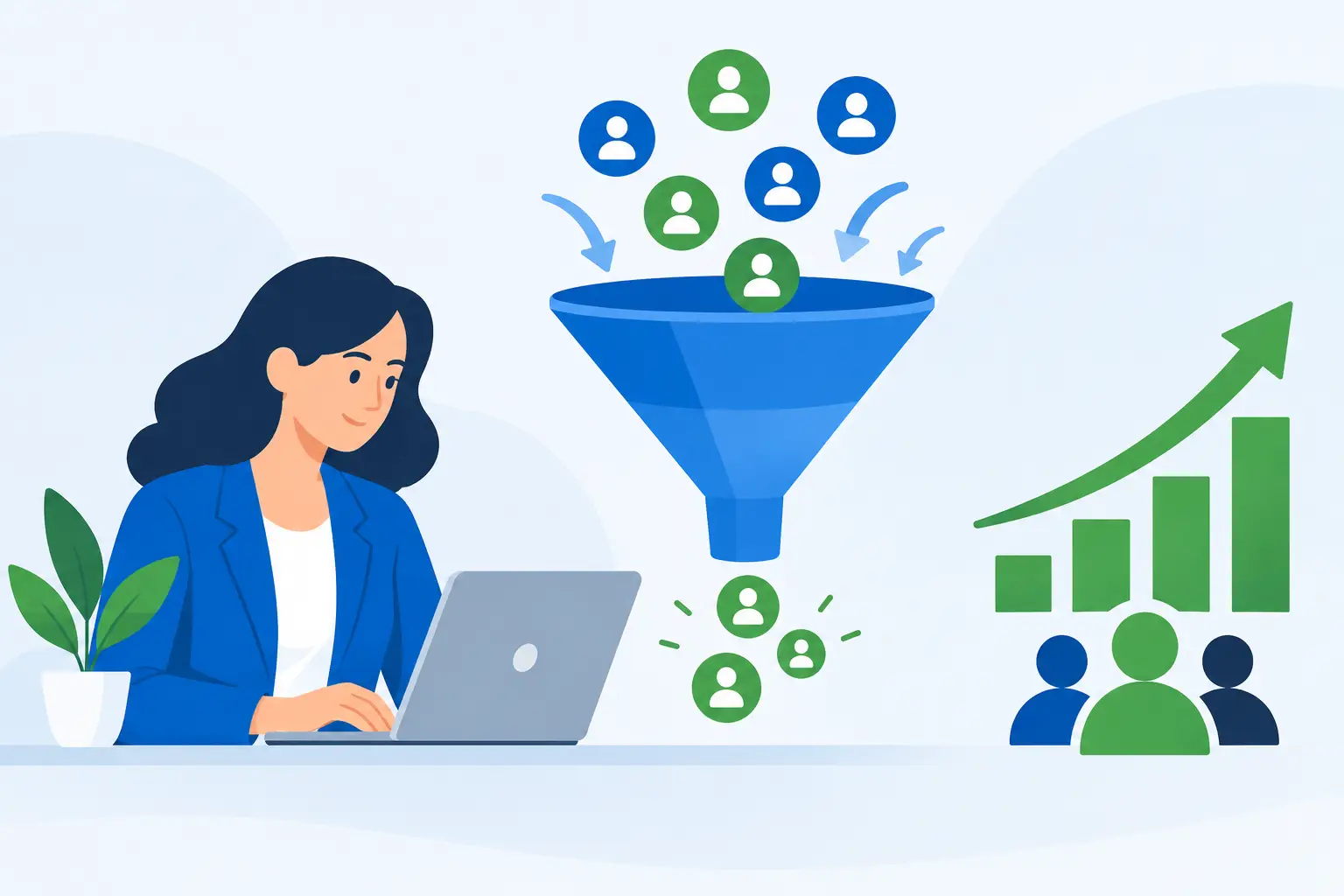
Improve Your Website Funnel Conversion Rate
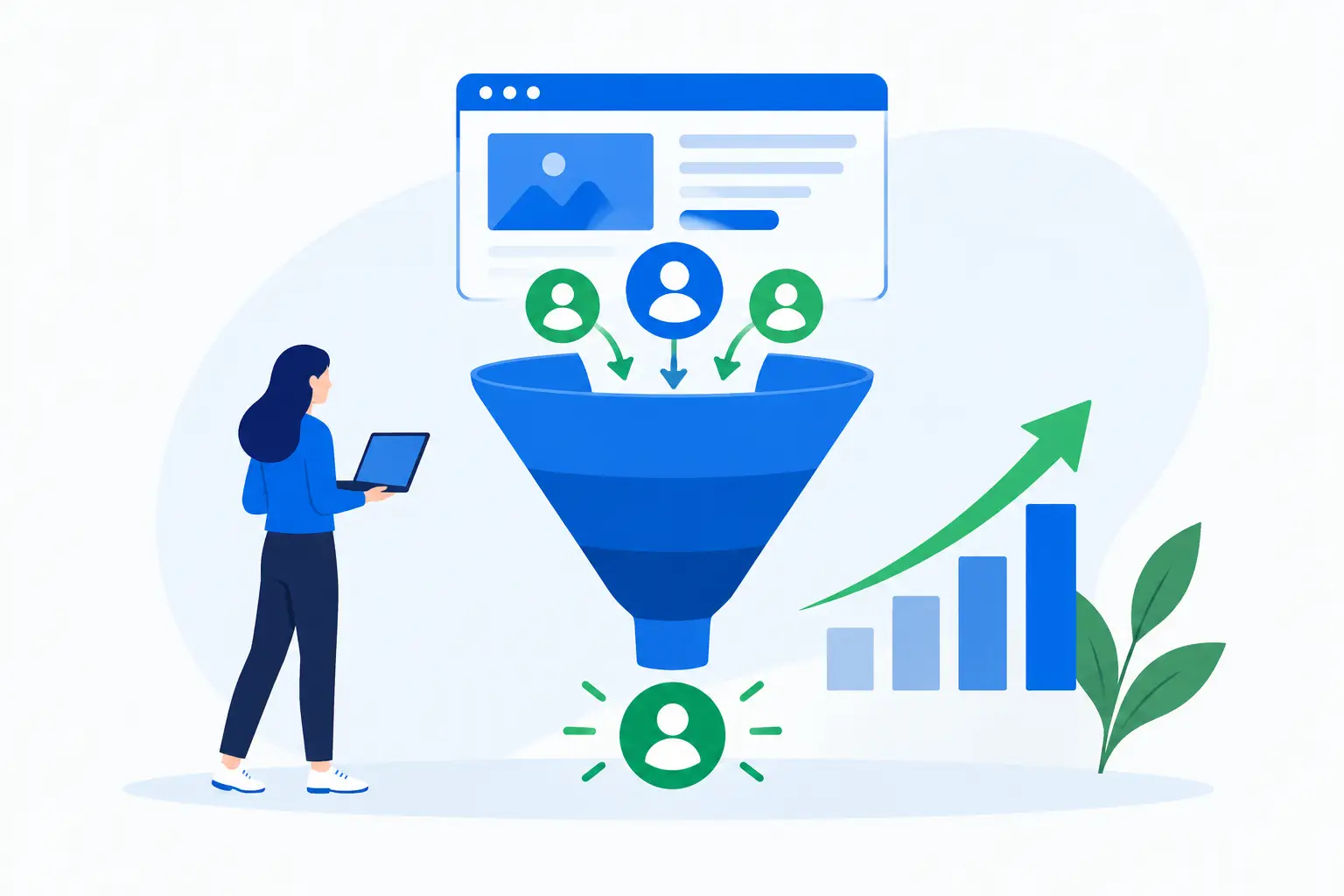
A $3,000 monthly ad budget can disappear fast when a website produces curiosity instead of calls. Your website funnel conversion rate tells you whether paid traffic is becoming real sales opportunities or quietly funding someone else’s growth. For a service business, a strong funnel is not about prettier pages. It is about getting the right prospect to take the next measurable step.
The math is simple: divide the number of desired actions by the number of visitors, then multiply by 100. If 500 visitors produce 25 booked consultations, your conversion rate is 5%. But the calculation only becomes useful when you define a conversion properly. A form fill from a homeowner outside your service area is not worth the same as a booked estimate from a qualified buyer who answers the phone.
For businesses buying Google Ads, this distinction protects profit. You do not need more traffic if half your current traffic leaves because the offer is unclear, the page is slow, or the next step asks for too much.
What a Good Website Funnel Conversion Rate Looks Like
There is no honest universal benchmark. A personal injury law firm, a med spa, and a commercial cleaning company have different sales cycles, ticket values, urgency levels, and lead qualification standards. Anyone promising a single industry-wide number without seeing your traffic and offer is guessing.
Still, direction matters. For high-intent local service traffic, a website funnel built around one clear service and one clear action can often target a 10% to 20% conversion rate. That may mean calls, booked appointments, quote requests, or qualified applications. Broader traffic, higher-ticket services, and longer consideration cycles can convert lower while still producing better economics.
The number to watch is not conversion rate in isolation. Look at cost per qualified lead, show rate, close rate, customer value, and gross margin. A page that converts 15% of visitors into low-quality inquiries can lose to a page converting 8% into prospects your team closes quickly. Volume without qualification creates a payroll problem for your sales team.
Where Service Business Funnels Usually Leak
Most weak funnels do not fail because of one catastrophic mistake. They lose prospects in a series of small, expensive moments. A visitor clicks an ad for emergency HVAC repair and lands on a general homepage. They have to hunt for the service, wonder whether you serve their neighborhood, and face a generic "Contact Us" button. By the time they find the form, they have already decided calling the next company is easier.
The first leak is message mismatch. The language in the ad, search query, landing page headline, and call to action should describe the same problem and next step. If someone searches "Chicago bookkeeping for contractors," a page talking broadly about financial solutions forces them to interpret whether you can help. Make them work, and they leave.
The second leak is weak proof at the moment of doubt. Service buyers are hiring people, not downloading software. They want evidence that you understand their problem, do the work well, and will respond. Specific results, relevant credentials, service-area clarity, short testimonials, and a straightforward process reduce perceived risk. Empty claims such as "trusted experts" do not.
The third leak is friction. Long forms, unclear scheduling, slow mobile pages, pop-ups that block the page, and phone numbers that are hard to tap all cost leads. Ask only for what is needed to start the conversation. You can collect project details after the prospect has raised their hand.
Start With the Economics, Not the Design
Before changing a headline or button color, establish what a lead is worth. Suppose your average customer generates $4,000 in gross profit, you close 25% of qualified consultations, and 70% of leads are qualified. A raw lead is worth roughly $700 in expected gross profit before sales and delivery costs. That gives you room to decide what you can responsibly pay to acquire one.
Now compare that number with reality. If you spend $2,000 to generate 20 leads, your cost per lead is $100. If only eight are qualified and two become customers, you acquired $8,000 in gross profit. The funnel may be viable. If your team contacts those leads two days later and only one answers, the marketing channel gets blamed for an operational failure.
Track the whole chain: ad click, landing-page visit, call or form submission, qualified lead, appointment booked, appointment attended, sale, and revenue. A website cannot fix a slow sales follow-up process, but your reporting should show where the loss occurs. Without that visibility, owners often keep optimizing the wrong stage.
Use one primary action per page
A funnel page should answer one question: what should this visitor do next? For an urgent service, that may be call now. For a considered service, it may be book a consultation or request a quote. Giving equal visual weight to six navigation options, social profiles, a newsletter, and three unrelated services scatters attention.
This does not mean removing every detail. It means arranging details to support the primary decision. Put the value proposition first, explain the outcome and fit, show proof, handle common objections, and repeat the action when the prospect is ready. The page should feel like a competent salesperson, not a digital brochure.
Match the ask to buyer intent
High-intent prospects can handle a direct booking request. Lower-intent prospects may need a smaller commitment, such as a pricing review, service-area check, or short assessment. The trade-off is lead quality. Easier offers typically create more inquiries but require stronger qualification. Bigger commitments reduce volume but can improve close rates.
Test the offer based on actual sales capacity. If your team has room for ten consultations per week and can follow up fast, a simple booking path may make sense. If each project requires careful screening, use a short pre-qualification form that filters obvious mismatches without making good prospects complete an application.
How to Improve Conversion Without Guesswork
Start by watching actual user behavior and listening to sales calls. Look at mobile versus desktop conversion, search terms, call recordings, form abandonment, time to first response, and the reasons leads do not move forward. A page may appear to have a conversion problem when the real issue is that ads are attracting people looking for a service you do not offer.
Then prioritize changes by financial impact. Fix a broken phone tracking setup before debating button colors. Create dedicated pages for your highest-margin services before rewriting a low-traffic about page. Improve response time before increasing ad spend. The best next move is the one that can recover the most dollars, not the one that feels most creative.
Run controlled tests when traffic volume allows it. Change one meaningful variable at a time: the offer, headline, proof, form length, or call to action. Keep enough time in the test to account for weekday patterns and lead quality. Declaring a winner after three conversions is how businesses make expensive decisions on noise.
A useful review cadence is weekly for lead quality and speed-to-lead, then monthly for funnel economics. Your team should be able to answer: Which campaigns create qualified conversations? Which pages convert those visitors? How much revenue results? If the answer lives in three disconnected tools and someone’s memory, you do not have a system yet.
The Conversion Rate Is a Management Number
Your website is part of the sales operation. It sets expectations before the first conversation and determines whether paid demand turns into an opportunity your team can close. Treating it as a one-time design project leaves money on the table every month.
Nils Digital has worked with more than 200 businesses, and the pattern is consistent: the fastest gains come from identifying the exact bottleneck, putting a dollar value on it, and fixing the highest-impact issue first. No vague traffic reports. No vanity metrics presented as growth.
Ready to turn your website into a client-getting machine? Book a free strategy call with Nils Digital and bring the numbers you have. We will tell you where the funnel is leaking, what it is costing, and whether fixing it is worth the investment.