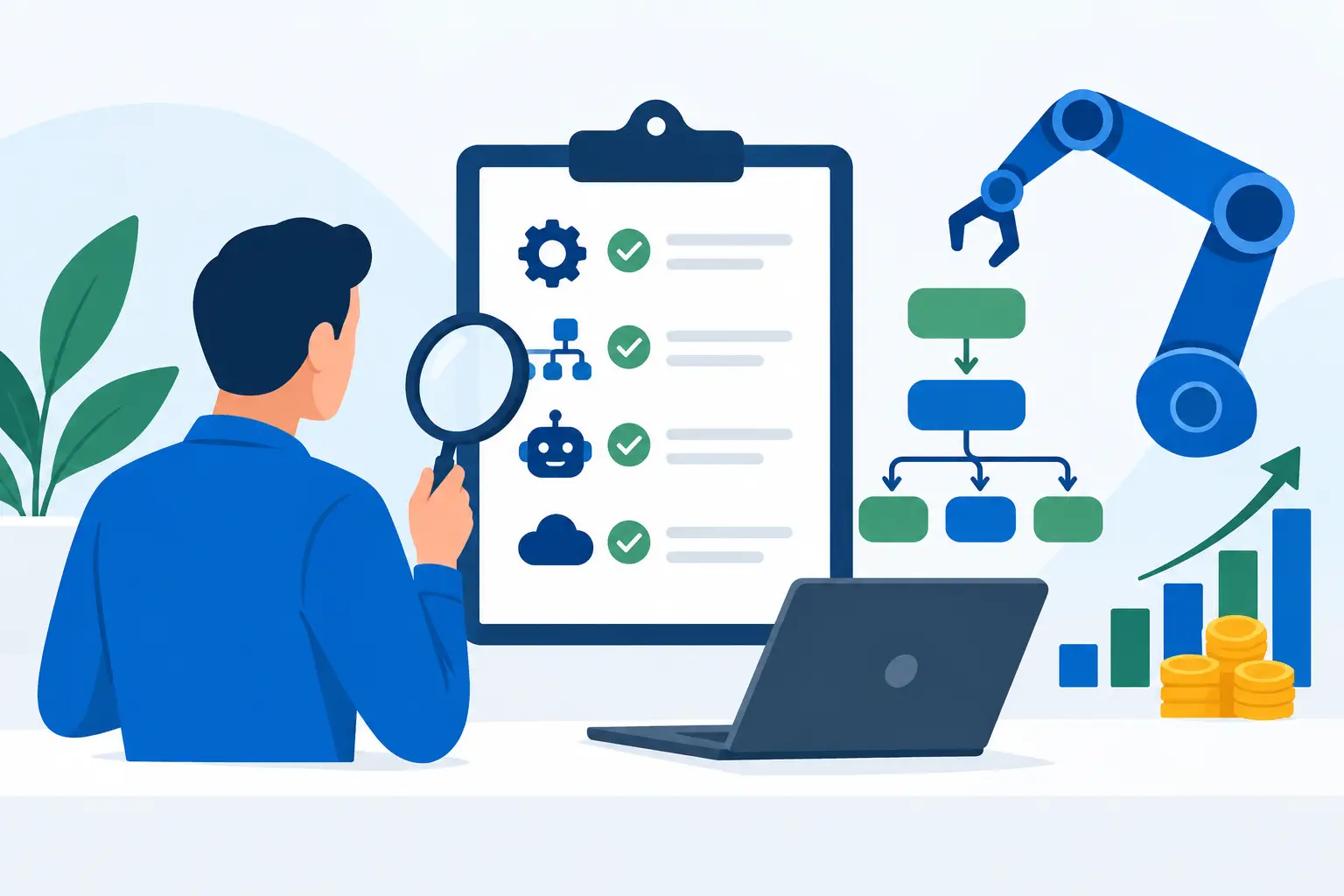
Service Business Automation Strategy That Pays

Most service businesses do not have an automation problem. They have a prioritization problem.
A bad service business automation strategy looks busy on paper and weak in the bank account. It automates a few reminders, adds a chatbot nobody asked for, and still leaves your team buried in follow-ups, handoff errors, missed invoices, and work that depends on one person remembering the next step. If the result is not recovered hours, recovered dollars, or faster throughput, it is not strategy. It is software shopping.
The businesses that get real value from automation start somewhere less exciting. They look at where time leaks, where deals stall, where fulfillment slows down, and where payroll keeps rising to support work that should have been systemized a year ago.
What a service business automation strategy actually is
A service business automation strategy is a financial plan disguised as an operations plan. Its job is not to add more tech. Its job is to remove friction from the parts of the business that affect revenue, margins, and capacity.
That means you do not begin with tools. You begin with math.
How many hours does your team spend chasing intake forms? How many leads go cold because nobody followed up fast enough? How much revenue is delayed because billing starts late, proposals sit untouched, or onboarding requires six manual emails and two internal nudges? Those are the places where automation earns its keep.
For a local service business, a clinic, a real estate team, or an agency, the same rule applies: the best workflow to automate is usually the one that repeats often, breaks often, and costs enough that fixing it changes the month.
Start with operational bottlenecks, not shiny tools
Owners usually know where the pain is. They just have not translated it into a clear sequence.
A lead comes in. Someone manually qualifies it. Another person sends a booking link. The prospect fills out part of a form, then stops. A staff member follows up a day later. The call gets booked, but notes live in one system, the proposal in another, and nobody updates the pipeline until the end of the week. After the sale, onboarding starts late because the handoff happened in Slack and got buried.
Every step feels small. Together, they create drag across the entire business.
That is why a serious automation strategy maps the full client journey, not just one isolated task. Marketing, sales, onboarding, fulfillment, billing, and reporting all connect. If you automate one section while the next stage is still manual and messy, you move the bottleneck instead of removing it.
This is also where a lot of DIY automation projects fail. They optimize one team’s convenience rather than the business outcome. A prettier intake form is nice. A system that cuts no-show rates by 20%, shortens time-to-close, and gets invoices out same day is better.
Where automation usually creates the fastest return
In most service companies, the highest-return opportunities are not hard to find. They sit inside repetitive workflows with direct labor cost or revenue consequences.
Lead handling is one of the obvious ones. If response time is slow, automation can route new inquiries instantly, trigger qualification, assign follow-up, and keep prospects moving without waiting for a staff member to notice a notification. That matters because speed affects close rate.
Onboarding is another. Many firms lose momentum right after the sale. Agreements are signed, but account setup drags. Documents arrive late. Internal tasks are unclear. Clients feel friction before work even starts. Automating the handoff, task assignment, reminders, and status visibility often recovers hours and improves retention at the same time.
Billing is often worse than owners think. In many businesses, invoices go out late because completion data is not centralized, approvals are manual, or someone has to remember which client gets billed on which schedule. That creates cash flow drag and unnecessary admin payroll. A good system shortens the path from work delivered to money collected.
Then there is fulfillment. This is where trade-offs matter. Not every delivery process should be heavily automated. High-touch service can be a competitive advantage. But the repeatable parts - status updates, internal triggers, checklist completion, file requests, approvals, scheduling - usually should be. The goal is not to replace judgment. It is to protect it from admin work.
How to prioritize your service business automation strategy
The right order is simple: start with what has the clearest financial impact and the shortest path to implementation.
A practical way to score opportunities is to look at four factors. First, frequency. If a workflow happens 50 times a week, small improvements stack fast. Second, labor load. If your team spends hours on it, there is payroll to recover. Third, revenue sensitivity. If delays or errors affect close rates, retention, or collections, the impact is bigger. Fourth, complexity. If a fix takes two weeks and saves meaningful time immediately, it moves ahead of the six-month rebuild.
That means the best first automation is rarely the most advanced. It is usually the most obvious high-friction process your team touches every day.
A lot of owners make the opposite choice. They start with AI because it sounds strategic. In reality, standard workflow automation often creates the first win, and AI becomes more useful after the process itself is clean. If your data is inconsistent and your handoffs are unclear, adding AI on top just makes confusion happen faster.
What to document before you automate
Before any build starts, get honest about how the work actually happens, not how you think it happens.
Document the trigger that starts the workflow, the steps that follow, who owns each step, which tools are involved, where delays happen, and what counts as a completed outcome. You also need edge cases. What happens if a prospect does not respond? What if paperwork is incomplete? What if a client changes scope mid-process? Good automation handles the common path and flags exceptions early.
This is where experienced operators save you time. They do not just ask what you want automated. They look for where your current process leaks money. If the analysis does not lead to numbers, it is not done yet.
At Nils Digital, that is the point of an audit. We map the workflows, quantify wasted hours and lost dollars, then rank fixes by financial impact. If we cannot back it with math, it does not make it into the roadmap.
The trade-offs most owners miss
Automation is not free money. It comes with maintenance, change management, and process discipline.
If your team does not trust the workflow, they will work around it. If your CRM is full of bad data, your automation will fire at the wrong time. If you automate a broken approval chain, you just make the broken chain harder to see. And if your service relies on white-glove communication, pushing too much into automation can make the client experience feel cheap.
That does not mean pull back. It means be precise.
Use automation for speed, consistency, reminders, routing, data transfer, task creation, and visibility. Keep humans where judgment, reassurance, negotiation, or exception handling matter most. The strongest systems are not fully automated. They are correctly divided.
What a good result looks like in 30 to 90 days
A strong service business automation strategy should produce changes you can feel quickly.
Your team spends less time asking what happens next. Leads get touched faster. Clients move through onboarding with fewer delays. Tasks are assigned without chasing. Invoices go out on time. Reporting becomes clearer because data is captured consistently at each stage.
Financially, that usually shows up in some combination of lower admin load, improved conversion, faster cash collection, and more delivery capacity without immediate headcount growth. Those are the outcomes that matter. Nobody cares how many automations you built if payroll keeps climbing and turnaround time does not improve.
The best part is that early wins create clarity for the next phase. Once intake, handoff, or billing is stabilized, it becomes easier to decide whether AI should support quoting, client communication, reporting, or internal knowledge access. Strategy gets sharper after the first numbers come in.
If you are serious about fixing operational drag, do not ask, “What can we automate?” Ask, “Where are we losing the most time and money every week?” That question usually leads to better answers, faster wins, and fewer expensive distractions.
Want to know exactly where AI could save you 20+ hours a week? Book a free call at nilsdigital.com/automation.