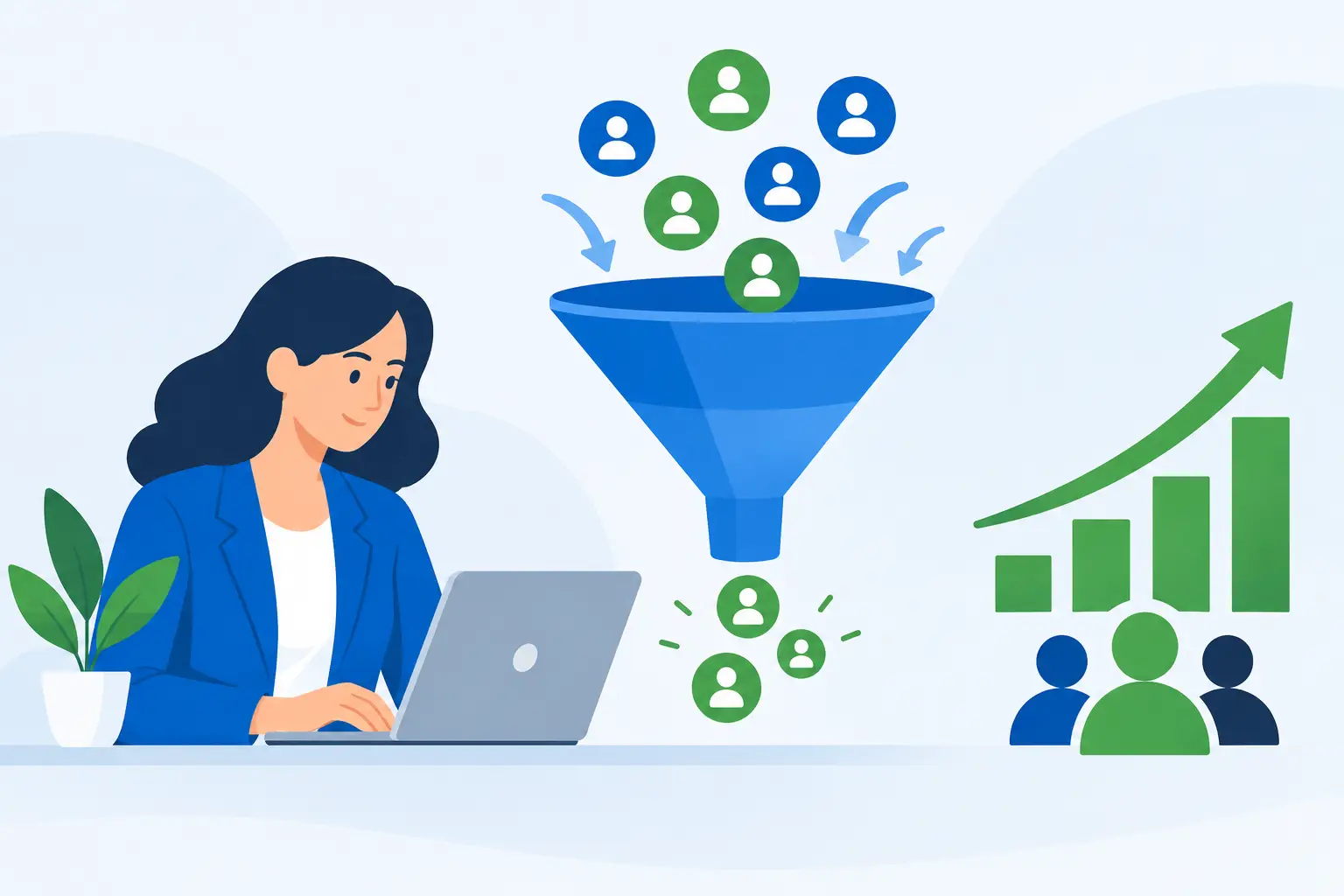
A Profitable Google Ads Funnel That Books Jobs
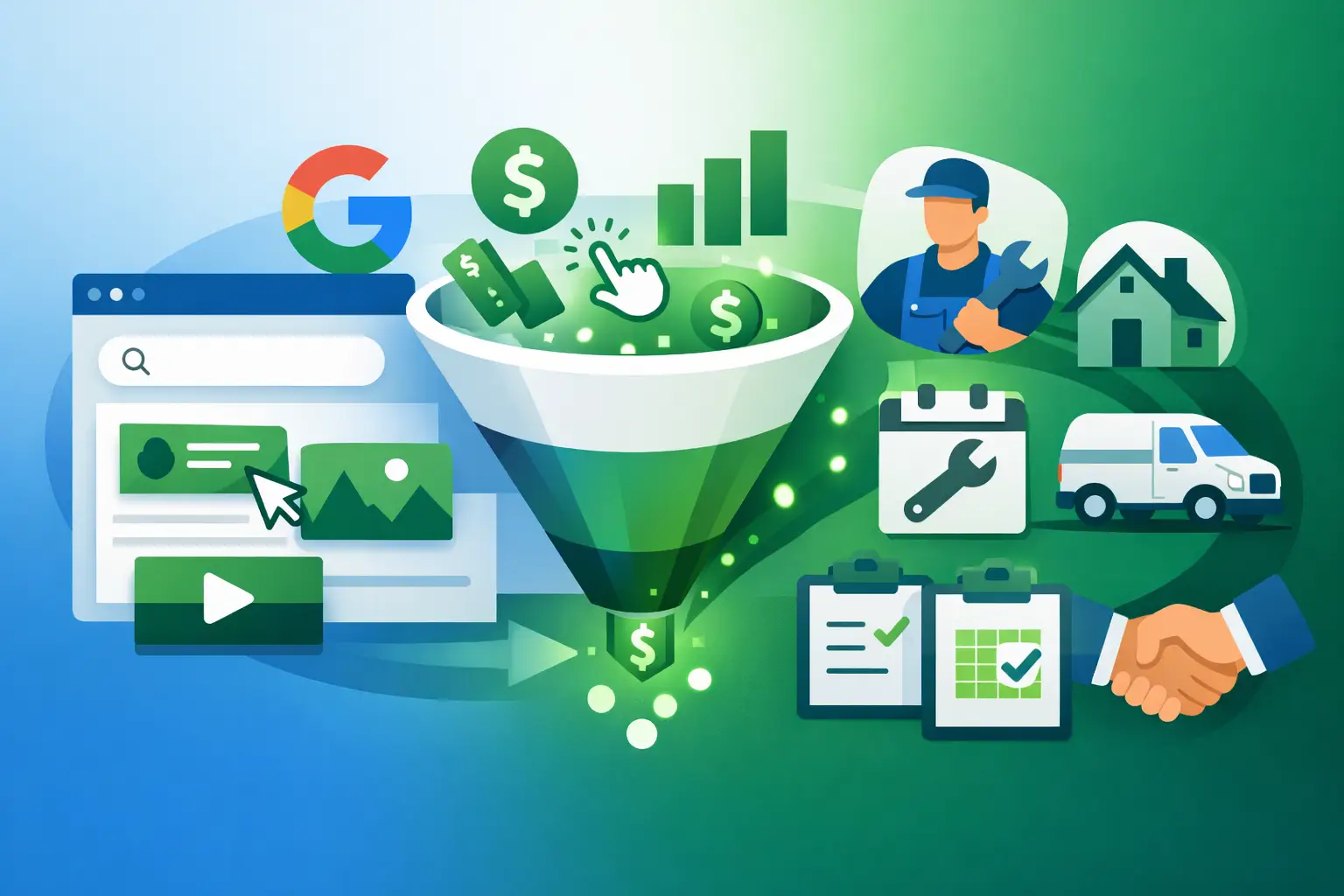
A click is not a lead. A lead is not a booked job. And a booked job is not automatically profitable.
That is where most Google Ads campaigns break down. The owner sees calls coming in, the agency sends a report showing impressions and clicks, and nobody asks the question that matters: did this campaign produce more gross profit than it cost?
A profitable Google Ads funnel is built backward from that answer. It connects high-intent search traffic to a page that earns action, a follow-up process that gets prospects contacted fast, and sales tracking that shows whether the work is worth scaling. Skip any one of those pieces and you can spend heavily while telling yourself the campaign is "working."
Start with the math, not the ad account
Before writing an ad or choosing a keyword, calculate what a new customer is worth. Service businesses often set a cost-per-lead goal based on instinct, then discover later that their sales team cannot profitably close leads at that price.
Start with average revenue per new customer, gross margin, close rate, and the percentage of leads that are actually qualified. If a $4,000 project carries a 50% gross margin and your team closes one in four qualified opportunities, you have $2,000 in gross profit per sale. You may decide to spend $400 to acquire that customer, leaving room for sales labor, overhead, and net profit.
That $400 is your allowable customer acquisition cost. At a 25% close rate, you can afford roughly $100 per qualified lead. If only half of inbound leads meet your criteria, your maximum cost per raw lead is closer to $50.
The numbers will vary. A law firm, med spa, roofing company, and commercial cleaning business should not use the same targets. But every one of them needs a target grounded in margin and close rate, not vanity metrics.
The four parts of a profitable Google Ads funnel
Google Ads gets blamed for problems that occur after the click. In reality, the channel is only one part of the system. A funnel that produces predictable revenue has four connected stages: demand capture, conversion, speed to lead, and closed-revenue feedback.
1. Capture buyers, not browsers
Local service businesses should begin with searches that signal immediate commercial intent. Someone searching "emergency plumber near me" or "Chicago commercial cleaning quote" is closer to action than someone researching "how does commercial cleaning pricing work."
That does not mean broad keywords never work. They can, particularly once a campaign has enough conversion data and a strong negative-keyword process. But broad match is not a substitute for strategy. If your budget is limited, start narrow and prove the economics first.
Separate campaigns by service line when the offers, margins, or landing pages differ. An HVAC company may profitably pay more for a full system replacement lead than a maintenance call. Combining both under one generic campaign makes optimization harder because the platform will chase the easiest conversion, not necessarily the most valuable sale.
Your ads should qualify as well as attract. Mention service area, the specific service, and a reason to act. If you only serve commercial clients or projects above a minimum value, say so. Paying for fewer but better calls beats filling the calendar with work your team does not want.
2. Send traffic to one clear decision
A homepage is usually a poor destination for paid traffic. It asks a prospect to navigate, compare multiple services, read the company history, and decide what matters. Paid search visitors already told you what they want. The page should answer that need directly.
A high-converting landing page makes the offer obvious above the fold: what you do, who it is for, where you serve, and what happens when the prospect contacts you. It needs proof that reduces risk, such as specific reviews, certifications, project outcomes, before-and-after examples, or years serving the local market.
The call to action should match the buying decision. For urgent services, that may be a phone call. For high-ticket or consultative services, it may be a booked estimate or strategy call. Asking every visitor to "contact us" is vague. Asking them to "Schedule your commercial site walkthrough" tells them exactly what they receive.
Form length is a trade-off. A short form creates more leads, including more weak ones. A longer form can improve lead quality but reduce total volume. Start by collecting only information your sales team will use to prioritize and prepare for the conversation. Name, phone, service needed, ZIP code, and project timing often do more work than a ten-question form.
For many local service campaigns, a well-built page can convert 10-20% of qualified paid traffic. That is not a promise that every business will hit the same range. Offer strength, competition, urgency, device mix, and trust all matter. It is a useful benchmark because a 3% page and a 12% page create completely different economics from the same ad budget.
3. Treat response time as part of the ad spend
If your team takes four hours to call a new lead, you are paying for opportunities your competitors may already have won. The funnel does not end when a form is submitted. It ends when a prospect either books, buys, or is disqualified for a documented reason.
Every new inquiry needs an immediate confirmation, a clear owner, and a response-time standard. In most service businesses, a human response within five minutes is materially better than waiting until the next open block on the calendar. That could mean the owner, a dedicated intake person, or a routing process that makes sure leads never sit unseen.
Calls should be recorded and reviewed. Forms should feed into a pipeline, not an inbox where they disappear. Missed calls need automatic follow-up. These are operational details, but they directly change your allowable ad spend. Improve contact rate and appointment rate, and the same Google Ads campaign becomes more profitable without adding a dollar to the budget.
4. Feed closed revenue back into the system
Google Ads can optimize toward form fills, phone calls, booked appointments, or qualified sales opportunities. If you only measure the easiest event, the platform will find more of it. That is how businesses end up with cheap leads that never turn into revenue.
Track the full path: keyword or campaign, lead source, contact outcome, appointment, quote, sale, and collected revenue. For call-driven businesses, distinguish between a real sales conversation and a wrong number, job seeker, vendor, or existing customer.
Once enough data exists, shift optimization toward qualified leads or closed opportunities. This takes more discipline than watching the Google Ads dashboard, but it prevents the common mistake of scaling a campaign that looks efficient at the top of the funnel and loses money at the bottom.
Fix the constraint before raising the budget
When a campaign underperforms, owners often make one of two bad moves: they pause it before there is enough data, or they keep spending while changing five variables at once. Neither produces clarity.
Find the constraint. If impressions are low, your targeting, bids, budget, or location coverage may be too restrictive. If clicks are expensive, competition and quality score may be the issue. If clicks are affordable but leads are weak, look at message match and the landing page. If leads are good but sales are poor, the problem may be response time, qualification, pricing, or follow-up.
Do not ask Google Ads to solve a sales-process problem. Likewise, do not rebuild a site because a campaign is targeting searches from outside your service area. A profitable funnel is managed as a system, which means each stage gets measured and fixed on its own terms.
What profitable growth looks like
The goal is not the lowest cost per click or even the lowest cost per lead. The goal is a repeatable acquisition system where every additional dollar has a credible path to producing more gross profit.
That often starts small. Prove one service, one market, and one conversion path. Once you know the cost to generate a qualified opportunity and the percentage that closes, you can scale with confidence. Add services, expand geography, test stronger offers, and increase budget only when your delivery capacity can handle the work.
Nils Digital has managed more than $2 million in ad spend for over 200 businesses, and the lesson is consistent: the companies that win do not treat Google Ads as a slot machine. They connect traffic, conversion, sales follow-up, and revenue data tightly enough to make decisions with math.
Ready to turn your website and ads into a client-getting system with numbers you can trust? Book a free strategy call with Nils Digital's marketing team.