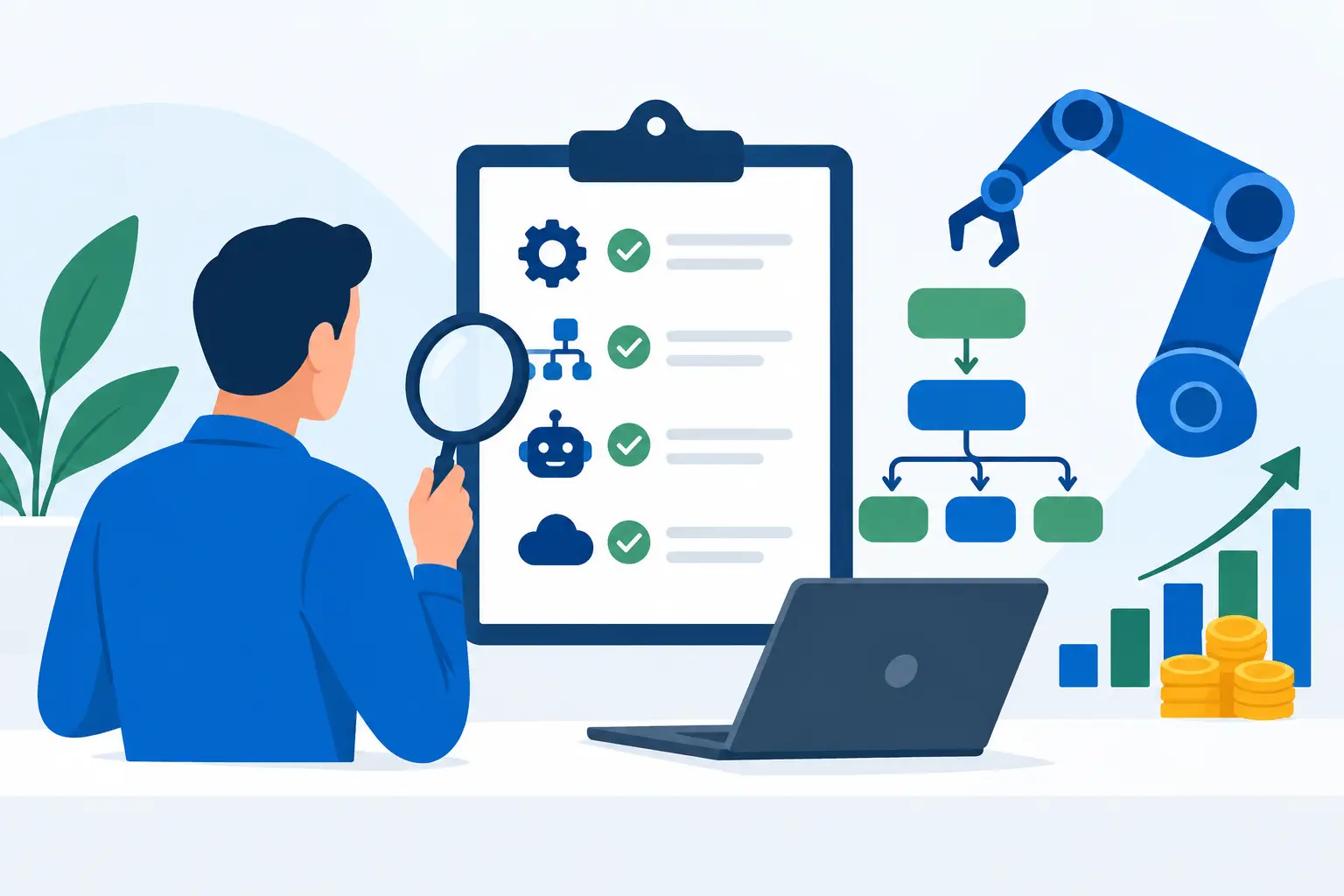
Do You Need a Business Process Automation Consultant?

If your team is still copying data between systems, chasing paperwork, re-entering invoices, or manually nudging every client through onboarding, you do not have a staffing problem first. You have a systems problem. A business process automation consultant is brought in to find where time, payroll, and revenue are leaking, then turn those leaks into measurable gains.
That matters more than most owners realize. Manual work rarely looks expensive in isolation. Five minutes here, ten minutes there, one missed follow-up, one delayed invoice, one onboarding error. But spread that across dozens of jobs, multiple staff members, and a full year, and the numbers get ugly fast. What feels like "just how we do things" often turns into tens of thousands in wasted labor and lost opportunities.
What a business process automation consultant actually does
A good consultant is not there to throw AI buzzwords at your team or sell you software you will never fully use. Their job is to map how work moves through your business, identify friction, quantify the cost of that friction, and recommend fixes in the order that makes the most financial sense.
That usually means looking across the full operating chain, not just one department. Marketing handoffs affect sales. Sales delays affect fulfillment. Fulfillment mistakes affect retention and referrals. Billing issues create cash flow problems that look unrelated until someone traces them back to the first broken handoff.
The best work happens when the consultant can answer three plain questions. Where is time being wasted? Where is money being lost? Which fixes pay back fastest?
If they cannot back their recommendations with math, you should be skeptical.
The real reason owners hire a business process automation consultant
Most companies do not hire this kind of help because they love efficiency projects. They hire because growth starts breaking the business.
A service company can get pretty far on hustle. The founder follows up personally. The operations manager remembers every exception. Someone on the team knows which spreadsheet matters. But once lead volume increases, client count rises, or service complexity expands, tribal knowledge stops scaling.
That is when the pain shows up in ways owners can feel immediately. Payroll grows faster than margin. Response times slip. Clients wait too long to get onboarded. Sales asks operations for updates no one can find. The same mistakes keep happening, and every fix depends on a person being available and paying attention.
Automation is not about replacing good people. It is about removing low-value work so good people can handle the judgment calls, relationship work, and exceptions that actually move the business forward.
Where automation usually creates the fastest return
For service businesses, the biggest wins are often boring on the surface. That is exactly why they pay off.
Lead intake is one common example. If a prospect fills out a form, books a call, gets tagged in the CRM, receives reminders, and is routed to the right rep without anyone touching it, you save admin time and reduce lead decay. If that same process is manual, even strong leads go cold.
Client onboarding is another. Many companies sell well and then immediately create friction after the deal closes. Documents are sent late. Intake forms are incomplete. Internal teams are missing context. Deadlines get pushed. An automated onboarding sequence does not just save time. It protects revenue by improving the client experience at the moment trust is still fragile.
Billing and collections are often ignored until cash gets tight. Automated invoice generation, payment reminders, status updates, and internal escalation rules can shrink delays and reduce awkward manual chasing. That is not glamorous work. It is profitable work.
Operational reporting can also be a major gain. If your team spends hours every week assembling updates from five tools just to understand capacity, job status, or pipeline health, that is a recurring tax on growth. Clean reporting automation gives owners faster decisions and fewer surprises.
What separates a useful consultant from an expensive one
Plenty of people can talk about automation. Far fewer can tie it to financial outcomes.
A weak consultant starts with tools. They ask which platform you want to use, then try to force your business into that platform's logic. A strong consultant starts with economics. They ask what each broken workflow is costing you now, what an improved version would save, and how quickly the change would pay back.
That difference matters because not every process should be automated right away. Some workflows are too messy and need to be simplified first. Some happen too rarely to justify the effort. Some depend on judgment and should stay human-led with lighter support around them.
A serious consultant will tell you where automation is a bad idea, or where the timing is wrong. That is usually a good sign.
How the process should work
The practical version is straightforward. First, they audit the current workflow. That means interviews, system review, handoff mapping, and identifying where work stalls, repeats, or fails. Second, they quantify impact. Hours lost per week, error rates, missed follow-ups, delayed billing, and the dollar value tied to each problem. Third, they prioritize fixes by ROI and implementation difficulty.
Only after that should they recommend tools, AI usage, or implementation steps.
This is where many engagements go sideways. Owners get pitched automation before anyone has measured the baseline. Then six months later they have more software, the same bottlenecks, and no clear return to show for it.
A good roadmap should tell you what to fix in the next 14 to 30 days, what can wait, what should stay manual, and what kind of payoff to expect if execution is done properly.
Red flags to watch for
If someone promises to automate your entire business in one sweep, that is usually a sign they do not understand service operations. Real companies have exceptions, edge cases, compliance concerns, and staff habits that do not change overnight.
Be careful with anyone who leads with generic AI language instead of process specifics. If they cannot explain how a workflow moves from trigger to action to exception handling to reporting, they are probably selling hype.
You should also be wary of consultants who disappear after strategy. Advice has value, but a lot of businesses have already paid for slide decks that never turned into results. If implementation is part of the offer, ask who does the work, how fast they respond, and whether execution is outsourced. That part matters more than most sales calls admit.
When hiring a consultant makes sense
It makes sense when your business has enough volume for inefficiency to be expensive. Usually that means you already have recurring leads, active clients, a team, and processes that happen often enough to measure.
If you are still very early, the right move may be to simplify your process before automating it. There is no value in speeding up a bad workflow.
But if you are established and your team is buried in repetitive work, waiting has a cost. Every extra month of manual operations means more payroll absorbed by tasks that should not require human attention, more handoff errors, and more growth pressure on the same weak foundation.
For many owners, the best first step is not implementation. It is getting a clear picture of where the biggest wins actually are.
That is why an audit-first approach tends to outperform software-first buying. You get clarity before commitment. You see where the money is. You can decide whether to build internally, hire outside help, or phase the work over time.
At Nils Digital, that is how we approach it. We map workflows across marketing, sales, fulfillment, onboarding, billing, and operations, then rank opportunities by financial impact. If a recommendation cannot be justified with recovered hours, recovered dollars, or both, it does not make it into the plan.
The right business process automation consultant is not selling automation for its own sake. They are showing you exactly which broken processes are holding back profit, capacity, and growth, and which changes will pay for themselves first.
Want to know exactly where AI could save you 20+ hours a week? Book a free call at nilsdigital.com/automation.