Billing Automation for Service Businesses
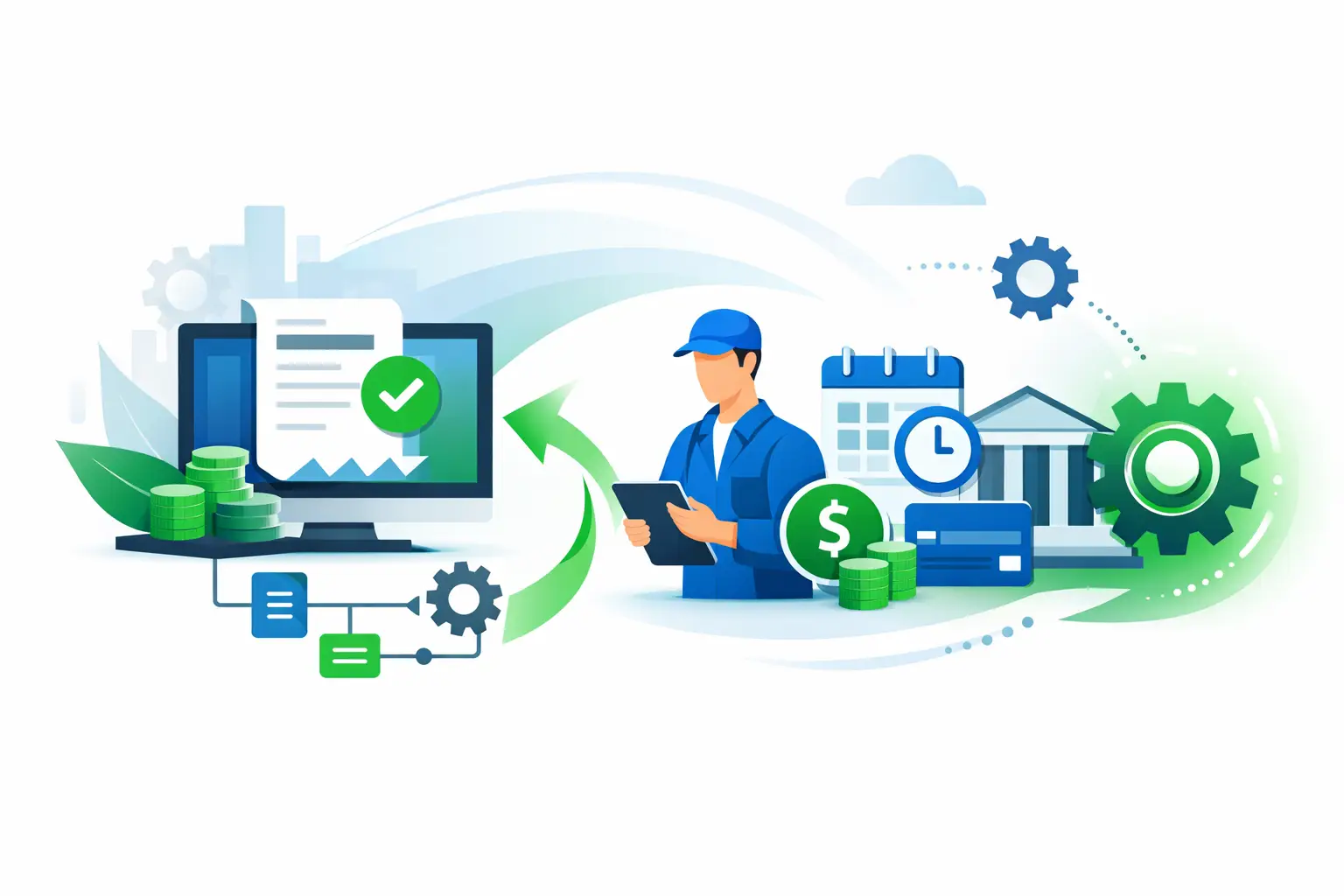
Your team should not be chasing signatures, rebuilding invoices from scratch, and sending payment reminders one by one at 4:45 p.m. on a Friday. Yet that is exactly how a lot of service companies handle billing until growth exposes the cost. What felt manageable at $30,000 a month starts breaking at $100,000. Billing automation for service businesses fixes that, but only if you treat it like an operations decision tied to cash flow, labor cost, and client experience - not just a software upgrade.
For most owners, the pain shows up in three places at once. Money comes in late. Staff spends too many hours fixing preventable mistakes. Clients get a sloppy experience right when you are asking them to pay. If billing touches proposals, approvals, onboarding, service delivery, renewals, and collections, then it is not a back-office detail. It is part of your revenue system.
What billing automation for service businesses actually means
A lot of companies hear "automation" and picture a tool that sends invoices on a schedule. That is one small piece of it. Real billing automation for service businesses connects the full chain: customer data, scope, pricing, invoice creation, payment collection, reminders, failed payment follow-up, and reporting.
In a healthy setup, the work happens once. A signed agreement triggers the right client record. The right service package, billing terms, start date, and payment method flow into the invoice automatically. Recurring work bills on time. One-time work invoices when a milestone is completed. Overdue reminders go out without staff intervention. Failed cards trigger a retry sequence and an internal task if needed. Finance can see what is pending, collected, late, and at risk without assembling a spreadsheet from five systems.
That does not mean every business needs a fully custom stack. It means your billing process should stop depending on memory, inbox searches, and whoever happens to be available that day.
The hidden cost of manual billing
Owners usually underestimate billing waste because it is spread across payroll, delay, and error. One admin person spending 8 hours a week on invoice prep, reminder emails, and payment reconciliation does not look catastrophic on paper. But at even $25 to $35 an hour fully loaded, that is roughly $10,000 to $15,000 a year on work that software should handle.
Then add delay. If your average monthly billings are $80,000 and automation shortens collection time by even 7 days, that improves working capital fast. The exact value depends on your margins and payment cycles, but any operator who has covered payroll while waiting on receivables knows this is not theoretical.
Errors are the third leak. Wrong amounts, missed line items, duplicate invoices, billing after a cancellation, or forgetting to collect a deposit all create cleanup work. Worse, they damage trust. Clients are more tolerant of a tough price than a messy process.
Where automation produces the fastest ROI
Not every billing step deserves the same attention. The best starting point is the part of the workflow with a clear financial drag.
For recurring services, that is usually automatic invoice generation and payment collection. If you run monthly retainers, maintenance plans, managed services, or recurring advisory work, there is no reason staff should recreate the same invoice every month.
For project-based firms, the biggest win is often milestone billing. If invoices depend on someone remembering that phase two is complete, you will bill late. A simple trigger tied to project status can pull revenue forward.
For high-volume businesses, collections automation matters most. Reminder timing, failed payment retries, and escalation logic can recover a surprising amount of cash without adding headcount. We have seen businesses lose five figures a year simply because no one owned dunning consistently.
For regulated or approval-heavy companies, the ROI often comes from reducing disputes. Clear quote-to-invoice data flow means fewer mismatches between what was sold and what got billed.
How to evaluate your current billing process
Before you buy anything, map the workflow. That sounds obvious, but most teams skip it and end up automating a bad process.
Start with one invoice. Trace it from signed deal to cash received. Who enters the client? Where does pricing live? How are discounts approved? What triggers the invoice? Who checks accuracy? How are reminders sent? What happens when a payment fails? Where is revenue reported? If you cannot answer those questions quickly, your process is already more fragile than it looks.
Then put numbers on the friction. Count monthly invoice volume, average time to create an invoice, average days to collect, overdue percentage, failed payment rate, write-offs, and hours spent on follow-up. If you cannot measure the leak, you cannot prioritize the fix. At Nils Digital, that is the line we use internally too - if we cannot back it with math, it does not belong in the recommendation.
The right way to implement billing automation
The practical mistake is trying to automate every exception on day one. The smart move is to automate the 70 to 80 percent of billing events that are repetitive and predictable, then design clean handling for the exceptions.
Step 1: Standardize pricing and billing rules
Automation breaks when every client deal is a custom snowflake. You do not need rigid pricing, but you do need defined rules. Deposits, due dates, payment terms, late fees, recurring intervals, and milestone triggers should be documented.
If two account managers sell the same service with different billing logic, software will not save you. It will just make inconsistency faster.
Step 2: Connect billing to the system of record
The invoice should not depend on double entry. In most service businesses, the source data lives in the CRM, proposal tool, project system, or onboarding form. Pick the primary source and make it authoritative.
This is where many implementations go sideways. Teams keep billing isolated in accounting software while sales and operations live elsewhere. That gap creates rework and mistakes. The goal is simple: enter core client and pricing data once.
Step 3: Automate collection, not just invoicing
Sending an invoice faster helps. Getting paid automatically helps more. For recurring services, stored payment methods and autopay usually have the biggest impact on cash flow. For larger project work, scheduled reminders and approval workflows matter more.
There is a trade-off here. Some client bases resist aggressive autopay, especially in high-ticket professional services. That does not mean you skip automation. It means you adjust the approach by deal size, trust level, and buying context.
Step 4: Build exception handling
Credits, pauses, scope changes, partial payments, and cancellations happen. Good automation does not pretend they do not. It routes those cases clearly so they do not sit in limbo.
This is where founder-led service companies usually gain control quickly. Once exceptions are visible and assigned, billing stops relying on tribal knowledge.
Step 5: Track the numbers weekly
If automation is working, you should see movement in a few metrics fast: invoicing time, days sales outstanding, overdue balance, failed payment recovery, and admin hours. If those numbers do not improve, the automation is not finished. It is just installed.
Common mistakes that make automation fail
The first mistake is buying software before fixing process. The second is over-customizing too early. The third is ignoring the client side of the experience.
Clients need clear invoices, obvious payment options, and predictable timing. If your automated process sends confusing line items or surprise charges, you will create more disputes, not fewer.
Another common problem is automating around bad sales inputs. If scope, pricing, or contract terms are inconsistent upstream, billing inherits the mess. This is why the highest-ROI automation work usually spans sales, onboarding, fulfillment, and billing together.
There is also the staffing issue. Owners assume automation replaces admin work entirely. Usually it changes the work. Instead of manually sending invoices, your team handles exceptions, audits data quality, and manages edge cases. That is still a win, but only if roles are clear.
When billing automation is worth it
If you send more than a handful of invoices a month, have recurring revenue, chase overdue payments regularly, or rely on one employee who "just knows how billing works," you are already a candidate.
The strongest fit is a service business with stable demand and growing complexity. That includes agencies, home service companies, clinics, law firms, accounting practices, consulting shops, real estate teams, and compliance firms. Once revenue grows, manual billing stops being a harmless habit and starts acting like a tax on the business.
The exact setup depends on your model. A retainer-based agency needs something different from a project-based design firm or a clinic with mixed payers. But the business case is usually the same: fewer hours, fewer errors, faster cash.
The bigger point is this: billing is one of the rare places where operational improvement directly shows up in the bank account. You are not chasing vague efficiency. You are recovering labor and pulling cash forward.
If you want to know exactly where AI and automation could save time, recover revenue, and clean up billing bottlenecks, book a free call at nilsdigital.com/automation. The right fix is rarely "add more software." It is usually making the money path harder to break.