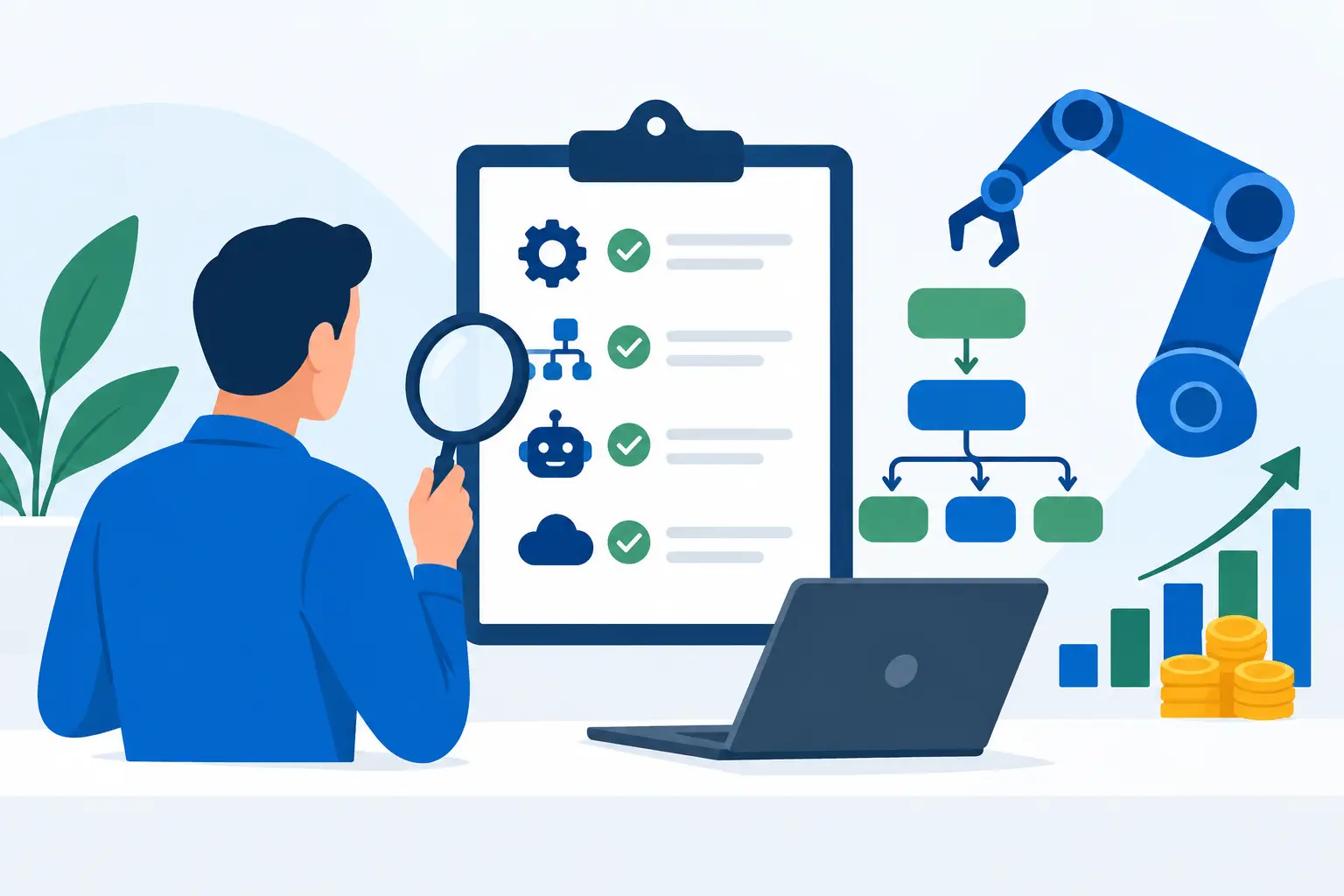
AI Automation Audit for Service Business

If your team is busy all day but growth still feels expensive, you probably do not have a staffing problem. You have a workflow problem. That is exactly where an ai automation audit for service business creates value - not by sprinkling AI on random tasks, but by finding where manual work is quietly draining margin, slowing response times, and capping capacity.
Most service businesses do not need more software. They need a clear view of where work gets stuck, where people are doing low-value repetition, and where delays are costing real money. The difference matters. A bad automation project adds tools. A good audit recovers hours, reduces errors, and shows you which changes will actually pay back.
What an AI automation audit for service business should actually do
A real audit is not a software demo and it is not a vague brainstorm about the future of AI. It should map how work moves through your business today, from lead intake to delivery to billing to follow-up. That means looking at what happens between systems, between people, and between departments, because that is where the biggest leaks usually live.
For a service business, those leaks tend to be painfully familiar. Leads sit too long before follow-up. Staff re-enter the same information across multiple systems. Onboarding requires five emails, three reminders, and one person checking whether documents were submitted. Client updates depend on someone remembering to send them. Invoices go out late. Collections happen inconsistently. Reporting takes hours at the end of the week because the data is scattered.
An effective audit turns those frustrations into measurable constraints. How many hours are being spent? How often do errors happen? What revenue is delayed or lost because response times are slow, handoffs are weak, or billing is inconsistent? If the audit cannot tie the problem to time, cost, capacity, or cash flow, it is not finished.
Where service businesses usually lose money
The biggest automation wins are rarely the flashy ones. They are usually hidden inside repetitive operational work that no one questions because it has been done the same way for years.
In marketing and sales, the issue is often speed and consistency. A lead form comes in, but routing is manual. Follow-up depends on who is available. Notes from calls never make it cleanly into the CRM. Proposal generation takes too long. Good opportunities cool off while the team is still organizing itself.
In onboarding and fulfillment, the damage comes from handoffs. Information collected by sales does not transfer cleanly to the delivery team. Clients are asked for the same details twice. Internal checklists live in different places. Status updates are manual. Small misses stack up into delays, confusion, and avoidable labor.
In billing and operations, the losses are quieter but just as serious. Invoices are created late. Payment reminders are inconsistent. Team members spend time chasing documents, checking statuses, and assembling reports. None of that work grows the business, but payroll keeps funding it every week.
This is why an audit has to be operational, not theoretical. The point is not to ask, “Where can AI fit?” The point is to ask, “Where are we paying humans to compensate for broken process?”
What a strong audit process looks like
The best audit starts with workflow discovery, not tool selection. You need to see the actual path of work. That includes intake channels, CRM usage, project management steps, communication patterns, approval bottlenecks, document handling, invoicing flow, and reporting.
From there, each workflow should be assessed through three lenses: frequency, friction, and financial impact. Frequency tells you how often the task happens. Friction shows how much manual effort, delay, or error it creates. Financial impact connects that friction to labor cost, missed revenue, slower cash collection, or reduced capacity.
That last part is where many consultants get lazy. They identify automation ideas, but they do not quantify the business case. For an owner or operator, that is useless. If an opportunity saves two hours a month, it is probably not urgent. If it saves 25 hours a week across intake, scheduling, and client communication while improving close rate and speeding billing, that deserves attention now.
A proper audit also prioritizes based on implementation reality. Some fixes are easy and deliver fast ROI. Others require process cleanup first. Some depend on better data hygiene. Some affect multiple departments and need change management. Not every problem should be solved in the first phase.
That is why a roadmap matters as much as diagnosis. You need to know what to do first, what to do later, what not to touch yet, and what each move is expected to return.
Why most automation efforts stall
Service businesses usually fail with automation for one of three reasons.
First, they automate a bad process. If your intake process is inconsistent, adding AI on top of it just helps the inconsistency move faster. The mess becomes more efficient, not more profitable.
Second, they buy tools before defining outcomes. A platform promises AI note-taking, AI scheduling, AI proposal writing, AI inbox management. The team adds subscriptions, but no one has mapped where those features fit into the actual operating model. Six months later, usage is patchy and results are unclear.
Third, no one owns the project tightly enough. Automation cuts across teams. Sales touches onboarding. Operations touches billing. Admin touches reporting. If implementation is handed off to disconnected vendors or junior freelancers, the result is usually partial setup, weak adoption, and no financial accountability.
This is where a hands-on audit has an edge. It forces the business to work from real constraints and real economics instead of vendor promises.
What good ROI looks like
The return from an AI automation audit for service business is not just labor reduction, though that is often the easiest number to spot. Good automation also increases responsiveness, reduces lead leakage, shortens turnaround time, improves client experience, and helps you serve more volume without hiring at the same pace.
For example, if your front office spends 15 hours a week routing inquiries, scheduling calls, sending reminders, and chasing missing intake details, that is a visible labor drain. But the hidden cost may be larger. Slow response times reduce conversion. Incomplete intake creates delays downstream. Staff context-switching lowers output elsewhere.
Now compare that to a workflow that captures inquiries, qualifies them, routes them correctly, triggers follow-up, collects required details, and updates core systems automatically. The labor savings matter. The consistency matters more. The business becomes easier to scale because growth no longer depends on more people holding the process together manually.
That said, ROI is not identical for every company. A clinic, a real estate team, a compliance firm, and a marketing agency all have different margin structures and bottlenecks. That is why cookie-cutter recommendations are a waste of time. The right answer depends on your workflow volume, team structure, current systems, and where delays are actually hurting economics.
What to expect from the deliverable
At the end of the audit, you should not be left with generic advice like “use AI for admin” or “consider automating onboarding.” You should walk away with a clear map of current workflows, identified failure points, quantified opportunity areas, and a prioritized implementation plan.
That plan should answer a few practical questions. Which workflows should be automated first? What is the expected time or cost recovery from each one? What systems are involved? What operational dependencies need to be fixed before rollout? What can your team implement internally, and what requires outside build support?
If the audit is strong, you keep value whether you hire the same team to implement or not. That matters. It means you are paying for clarity, not for a disguised sales pitch.
This is one reason founder-led firms tend to produce better audit work than bloated agencies or software resellers. They are closer to the diagnosis, closer to the implementation reality, and more accountable for whether the recommendations survive contact with your actual business. That is also why firms like Nils Digital position the audit as a real business asset, not a teaser deck.
When to get an audit
The best time is usually before you hire additional admin or operations staff to absorb growing complexity. If volume is increasing, response times are slipping, and your team is spending more time managing process than delivering value, the business is giving you a warning.
You should also look at an audit after a failed automation attempt. Many owners assume automation does not work when the real issue was poor diagnosis. If the first effort started with tools instead of workflows, you probably never had a fair test.
And if you already know your team is buried in repetitive work, do not wait for a full operational breakdown. Small inefficiencies compound. They become payroll drag, slower cash flow, and service inconsistency long before they show up on a dashboard.
The businesses that get the most out of automation are not the ones chasing trends. They are the ones willing to measure where time and margin are being lost, fix what is broken, and implement changes in the right order. That is the real value of an audit. It gives you a way to stop guessing and start recovering profit from work your business should not still be doing by hand.